
Mapping Dealer Protocol Shifts to Player Choice Matrices Across Digital Rule Variants
Digital table game environments have seen dealer protocol adjustments that align with evolving rule variants, and observers note how these changes reshape the matrices players use to select actions like hitting, standing, or splitting. Researchers tracking these patterns across platforms report that protocol variations, such as modifications to dealer hit-soft-17 rules or card-draw sequences, require corresponding updates to decision frameworks that account for deck penetration, payout structures, and variant-specific constraints.
Digital Rule Variants and Their Core Components
Rule variants in digital formats differ by region and operator, with some incorporating multi-deck shoe configurations while others rely on continuous shuffle mechanisms, and data from regulatory filings show these distinctions directly influence how dealer actions unfold. Experts examining platforms in North America and Europe have catalogued dozens of such variants, each carrying distinct parameters that affect the timing and outcome probabilities tied to dealer protocols.
By June 2026 several operators plan to roll out revised digital interfaces that standardize certain protocol elements across variants, yet retain flexibility for localized adjustments. This development stems from coordination among technology providers and oversight bodies, including references in reports from the Nevada Gaming Control Board that highlight the need for consistent mapping between protocol changes and player options.
Dealer Protocol Adjustments in Practice
Dealer protocols in digital settings encompass scripted behaviors for revealing hole cards, determining whether to hit on soft seventeen, and managing burn cards or cut procedures, and studies indicate these elements shift when platforms migrate between variants. People who analyze transaction logs from online systems find that even minor protocol tweaks, such as altering the sequence of card reveals, can expand or contract the viable choices available to players at each decision point.
What's interesting is how continuous shuffle variants demand protocols that reset more frequently than traditional shoe-based games, forcing matrices to recalibrate probabilities in real time. Figures from industry analyses reveal that platforms adopting these shuffles have documented measurable differences in average decision cycles per hand compared with static-deck formats.
Constructing Player Choice Matrices
Player choice matrices compile probabilities, expected values, and conditional actions into grids that guide responses under specific rule conditions, and analysts have developed software tools to regenerate these matrices whenever dealer protocols change. Data indicates that matrices for variants allowing surrender or double-after-split options contain additional rows and columns that reflect those expanded choices, whereas stricter variants produce more compact frameworks.
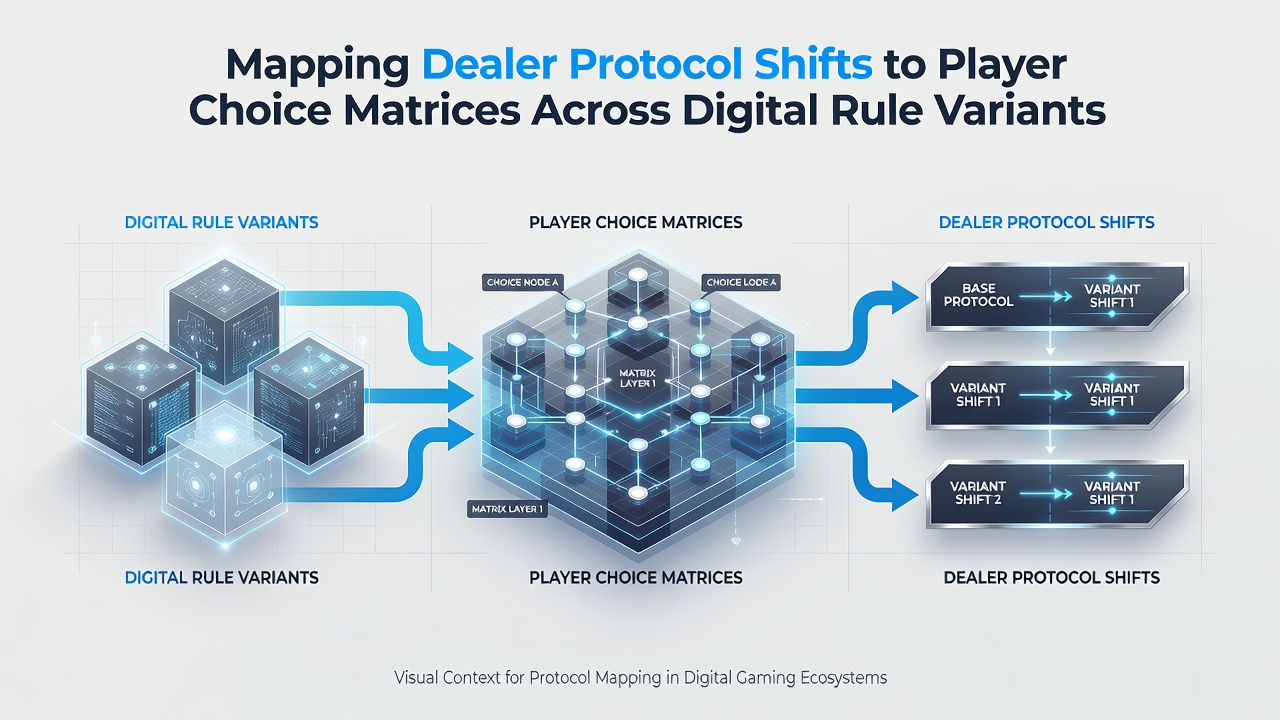
Mapping occurs through algorithmic translation of protocol parameters into matrix cells, and researchers at academic institutions have published methodologies that automate this process using simulation engines. One study from the University of Nevada, Reno examined how a shift in dealer standing rules altered optimal play percentages across five distinct digital variants, showing clear numeric divergences in recommended actions.
Turns out the translation process also accounts for platform-specific latency and animation timing, which can subtly affect player perception of when decisions must be registered. Reports from the Malta Gaming Authority document cases where synchronized protocol and interface updates produced measurable changes in player adherence to matrix outputs.
Integration Across Platforms and Regions
Cross-platform integration requires that matrices remain portable when players move between operators, and regulatory frameworks in Canada and Australia have begun to reference standardized mapping protocols to facilitate such movement. Observers tracking these efforts note that shared data formats allow a single matrix update to propagate across multiple rule variants without requiring complete reconstruction.
Here's where it gets interesting: when a protocol change involves the introduction of side-bet options tied to dealer up-cards, matrices must incorporate new decision branches that were previously absent. Evidence from transaction datasets shows increased complexity in these branches, yet also demonstrates that automated mapping tools can maintain consistency across hundreds of simultaneous sessions.
Conclusion
The systematic mapping of dealer protocol shifts onto player choice matrices provides a structured way to maintain strategic coherence across digital rule variants, and ongoing documentation by regulatory bodies and research groups continues to refine these processes. As implementations scheduled for June 2026 approach, the frameworks already in place offer scalable methods for adapting matrices to new protocol parameters while preserving alignment with underlying probabilities. This alignment supports consistent player guidance regardless of which digital variant is in use.