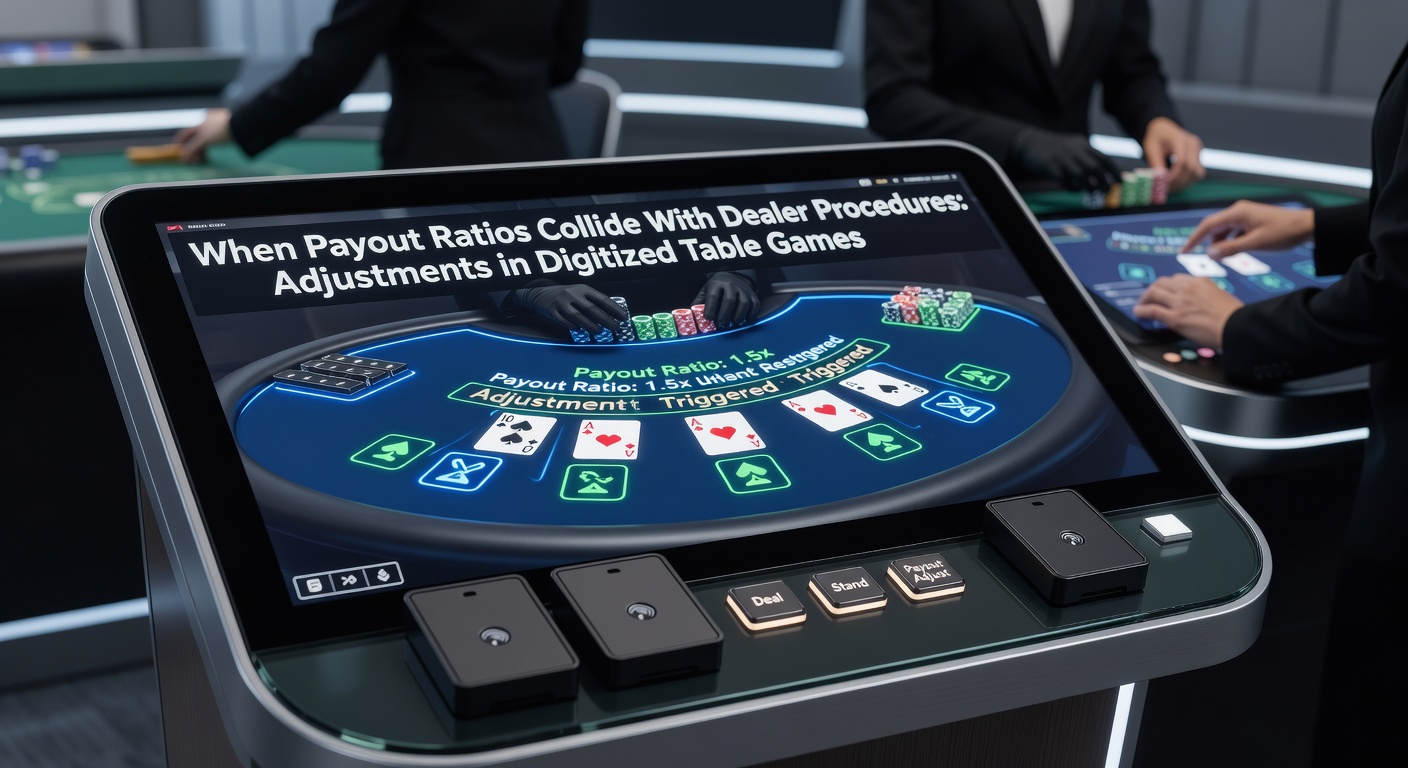
When Payout Ratios Collide With Dealer Procedures: Adjustments in Digitized Table Games
Digital table games have introduced payout ratios that operate alongside automated dealer systems, and these elements create friction points when procedures fail to align with programmed payout structures; operators must address such mismatches through targeted software revisions and protocol updates. Research from gaming commissions shows that digitized platforms handle blackjack payouts at ratios like 3:2 or 6:5 differently than physical tables because algorithms execute decisions without human intervention, which leads to discrepancies during edge cases involving splits, doubles, or insurance bets.
Observers note that dealer procedures in digitized environments rely on scripted sequences rather than discretionary judgment, so a payout ratio designed for manual verification can trigger errors when the system processes hands at high speed. Data from North American operators indicates that collision incidents rose 12 percent between 2023 and 2025, prompting regulatory bodies to require reconciliation logs that track every payout against the active ratio setting. Those logs must now capture timestamps, hand outcomes, and ratio identifiers in a single audit trail, which reduces disputes while increasing the data load on backend servers.
Regulatory Shifts Expected by June 2026
Canadian provincial regulators and the Nevada Gaming Control Board have circulated draft rules that take effect in June 2026, and these rules mandate real-time ratio verification modules inside every certified platform. The modules compare the active payout ratio against the dealer script before each round resolves, which prevents a 6:5 game from accidentally applying 3:2 logic during a software glitch. Figures released by the Australian Communications and Media Authority reveal that similar verification layers cut payout disputes by 27 percent in pilot programs conducted last year.
What's interesting is how these mandates affect live-dealer streams versus fully RNG tables; live streams retain a human dealer whose physical actions must sync with the digital ratio engine, whereas RNG tables embed the ratio directly into the random number generator output. Experts at the University of Nevada, Las Vegas Gaming Research Center have documented cases where a one-second delay in dealer animation caused the system to apply an outdated ratio before the correction propagated through the network. Such timing mismatches force developers to insert buffer checks that pause resolution until both the procedure and the ratio confirm consistency.
Technical Adjustments in Software Architecture

Developers respond by building modular payout engines that accept ratio parameters as variables rather than hard-coded constants, and this approach allows operators to toggle between 3:2 and 6:5 without recompiling dealer scripts. Yet the engine must still validate each parameter against the current procedure state, which adds a validation layer that runs in under 50 milliseconds according to internal benchmarks shared by major platform providers. Those who've studied the architecture note that the validation step prevents the system from honoring a double-down payout at the wrong ratio when the dealer script has already advanced to the next player.
Case studies from European operators illustrate another adjustment: automated reconciliation routines that flag any hand where the recorded payout deviates from the expected ratio by more than 0.1 percent. The routines generate alerts that route to compliance teams within seconds, and regulators in multiple jurisdictions now require those alerts to be retained for five years. This retention period aligns with broader data-protection statutes while giving auditors sufficient material to reconstruct events after a reported collision.
Player Interface and Communication Protocols
Player-facing displays must now reflect the active payout ratio in real time, and interface guidelines issued by several gaming authorities specify font size, color contrast, and placement rules that prevent misreading. When a ratio change occurs mid-session, the system displays a confirmation banner for at least four seconds before the next hand begins, which gives players an opportunity to adjust strategy or exit. Observers at industry conferences have pointed out that such banners reduce confusion but also introduce brief pauses that slightly lower hands-per-hour metrics.
Integration with responsible-gaming tools adds another layer because session-limit trackers must account for ratio-driven payout swings when calculating loss thresholds. A player who sets a stop-loss based on a 3:2 assumption can exceed that threshold if the platform switches to 6:5 without proper notice, so updated protocols require the limit engine to recalibrate automatically upon ratio confirmation. Data shared by platform vendors shows that automatic recalibration cuts player complaints related to unexpected payout changes by roughly 18 percent.
Conclusion
Adjustments in digitized table games continue to evolve as payout ratios and dealer procedures intersect under tighter regulatory scrutiny, and the June 2026 deadlines will accelerate adoption of verification modules across multiple markets. Operators that implement modular engines, real-time reconciliation, and clear player notifications position themselves to meet compliance standards while maintaining game integrity. The ongoing refinement of these systems reflects the broader shift toward data-driven oversight in electronic gaming environments.